World Cup Draft Guides
Short, practical guides for building a better XI in My World Cup XI. The game is simple to start: pick a shape, draft eleven players, simulate the cup. The hard part is drafting a team that fits together. These guides cover the draft, the chemistry bonus, the group stage and the penalties, so your next run has a plan behind it. Each guide is short enough to read before a cup and specific enough to change how you draft.
The draft decides most cups
The draft is where most cups are won. You get eleven picks and three rerolls. Each board offers a real World Cup squad that can fill an open slot. You do not get to choose the nation or the year. You choose the player.
That means fit beats fame. A 90-rated forward is only a 90 if he plays in a forward slot. If your formation still needs a centre-back, a famous striker will not fix it. Check the star marker before you pick. It shows whether the player fits the slot naturally.
The board is built to help. It only shows squads with at least one player who can fill a slot you still need. If the board looks bad, a reroll can keep the nation and change the year, or change the nation. You get three for the whole draft, so use them when a slot is blocked, not when a name is slightly better.
How a cup actually plays out
Your team joins a group with three AI sides. Two are weaker teams. One is a strong historical squad. Every team plays the others once. A win gives three points, a draw gives one and a loss gives zero. The top two advance.
The knockout bracket is a round of 16, quarter-final, semi-final and final. The rest of the bracket is simulated around your matches, so the whole tournament finishes fast. Ties go to extra time. If the score is still level, penalties decide. The group draw is different every run, so the same XI can get an easy group or a hard one.
Penalty shootouts use your five best takers, ranked by composure and finishing. Each side takes five kicks. The shootout stops early if one side cannot catch up. If it is still level, it goes to sudden death, one kick each. Finished runs stay in your match history, so you can review them or start a new draft.
Three draft plans to try
The spine plan: take a goalkeeper, a centre-back, a central midfielder and a striker in the first four rounds. Then fill the wide areas. This gives you a balanced XI with no obvious hole. It is the safest plan for a first run.
The nation core plan: pick one nation early and keep taking its players. Five same-nation players give the whole team a 10% bonus. A Brazil 1970 core or an Italy 2006 core can lift average role players. The risk is that the board may not offer your nation again, so keep a backup plan.
The era mix plan: take the best player available in every round, regardless of nation. This raises raw ratings but gives you no chemistry. It works when the board is generous and your slot fit is clean. It fails when you end up with eleven stars in the wrong positions.
How to scout a squad
Every squad card shows the average rating, the best player and the formation. Start with the best player. Brazil 1970 has Pelé. Argentina 1986 has Maradona. France 1998 has Zidane. A 95-rated star can carry a draft, but only if the rest of the XI fits around him.
Then look at the formation. Brazil 1970 played 4-2-4. Netherlands 1974 used total football. Italy 2006 built on defence. Spain 2010 controlled the ball. The shape tells you which slots the squad can fill. Pick squads that match the slots you still need.
Finally, check the depth. A high average means few weak spots. A top-heavy squad may leave you short in midfield. If you need two defenders, a squad with four strong defenders is more useful than a squad with one 95-rated forward.
Mistakes that cost cups
The first mistake is drafting names instead of roles. A 90-rated forward in a midfield slot is not a 90-rated player. Always check the star marker.
The second mistake is hoarding rerolls. You get three for the whole draft. If a board has no player for a slot you must fill, reroll. Saving all three for the last round usually leaves a hole.
The third mistake is ignoring chemistry. Eleven stars from eleven nations get no bonus. A core of five same-nation players gives the whole team +10%. That bonus often decides a close match. If you want to test it, draft five Brazilians and watch the chemistry bar.
What to read next
The first guide is How My World Cup XI Works. It walks through the full loop: formation, draft, chemistry, group, knockout and replay. It also explains the 2026 squads and the ratings.
After that, open the squad library. You can scout every team before you draft. Check the average rating, the best player and the formation. Then take that knowledge into the game and see if your plan survives the cup. Both pages are free and need no account.
FAQ
Do I need an account to play?
No. Your finished runs are saved in your match history in the browser. There is no sign-up and no password.
What formation is best for a beginner?
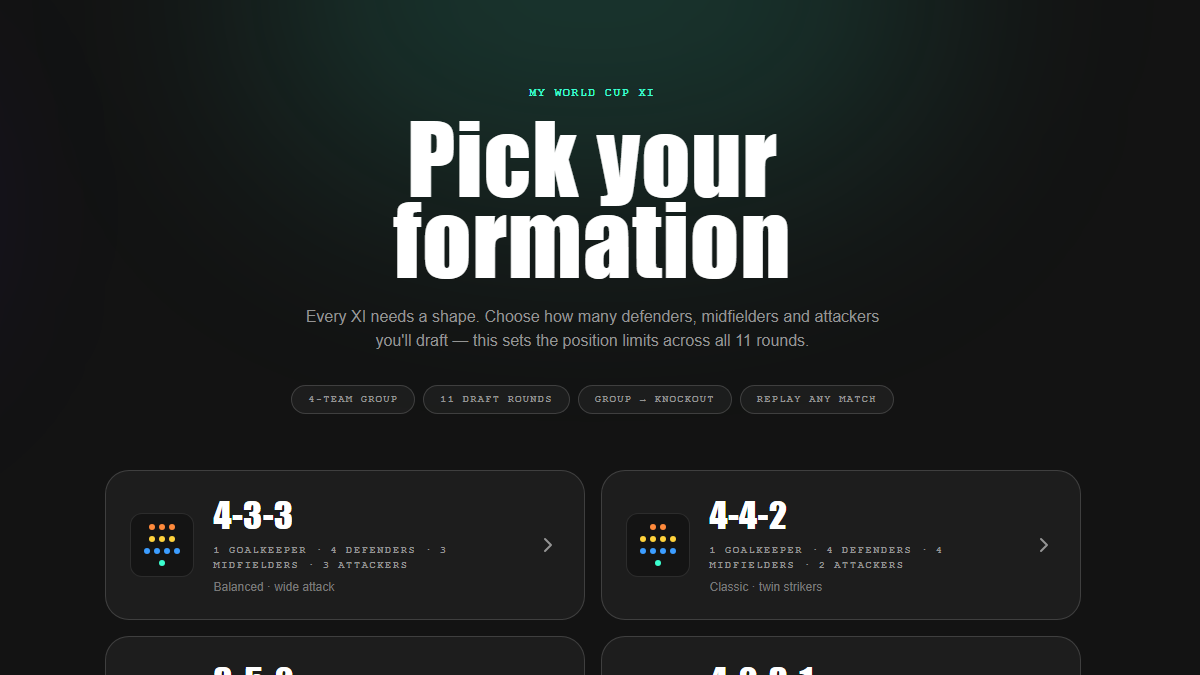
4-4-2 is the simplest. It asks for four defenders, four midfielders and two attackers, so the slots are easy to fill. Try 4-3-3 once you know which wingers you want.
How long does a cup take?
About ten to fifteen minutes. The draft is the slow part. The matches simulate quickly, and you can replay them.